
Research produced by Living Assessments spans a number of areas and aspects of children’s social care.
Poor evidence around ‘toxic trio’ poses questions for child protection
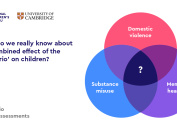
In 2020 our research with the Universities of Cambridge and Kent found little evidence to support the focus in child social work on the combined effect of the so-called 'toxic trio', and we called for the sector to unlearn the harmful assumptions behind this myth.
In 2023 we published a rapid review on early help, which contributed to the Independent Review of Children's Social Care by considering the evidence for services designated as ‘early help’. We found a range of positive outcomes for children and families, and a variety of interventions to support and strengthen families. Despite the difficulties in evaluating early help, there is a growing case for funding and delivering these services.
Building on our Rapid Review, in May 2022 we published our Evidence Paper on Investing in Prevention. NCB spoke to academic researchers about emerging evidence on the association between expenditure on children’s services, poverty and children’s social care demand. This evidence shows that increased spending on children’s social care preventative services (including family support and early help) has a positive impact on Ofsted judgements, numbers of Children in Need, and rates of 16 to 17-year-olds starting periods in care.
In 2024, we co-authored two Living Assessments CRIS data linkage publications with University of Cambridge colleagues. The analysis showed that many of the children and young people assessed by CAMHS professionals had experience of emotional abuse, violence towards others, destructive behaviour and not attending school.
Find the full journal article here.
Awards and recognition
Our collaboration with Dr Barry Coughlan from the University of Cambridge won the 2023 University of Cambridge’s Vice Chancellor’s Awards for Research Impact and Engagement, recognising its outstanding achievement, innovation and creativity in translating research into ambitious and transformational economic, social and cultural engagement and impact.
Our article on the adverse experiences faced by children and young people presenting to CAMHS was highly commended in the 2025 ACAMH Awards, which recognise high-quality work in evidence-based science, both in publication and practice, in the field of child and adolescent mental health.
CAMHS support for children and young people with social work involvement (COACHES)
The COACHES project (CAMHS Referrals and Outcomes for Adolescents and Children with Social Workers) was born out of Living Assessments’ Clinical Records Interactive Search (CRIS) infrastructure, with a focus on the effectiveness of mental health interventions for children with social workers. This project was designed in partnership with policymakers as part of Living Assessments to help create clarity and insights on how to best intervene early to support children with social workers with their mental health and wellbeing and to ensure they are safe and supported. The project continues after the end of Living Assessments.
Our first report in 2024 found that children and young people with social work involvement who were referred to CAMHS were three times more likely to be rejected from accessing mental health support.
The findings suggest a dedicated pathway for children with social work involvement to access CAMHS would be a significant step forward for a group of children who need more help.
Building up on this, in 2025 we published a second research paper with Cambridge which analysed the case notes associated with children and young people with social work involvement. The study found that in many cases children were rejected because their life was too “unstable” or their needs could be addressed by other parties – including social workers and mental health charities.
The same year, we outlined a new approach to attachment theory in social work, shifting the focus for practitioners from a child’s behaviour to their adult caregivers’ situation and actions, such as being attentive and receptive to the child’s needs or exhibiting behaviour that can be alarming or stressful for a child, such as symptoms of trauma.