
This online guide offers practical examples and resources for early years settings practitioners.
This good practice guide draws on evidence from the five A Better Start (ABS) partnerships Blackpool, Bradford, Lambeth, Nottingham and Southend and an Insights Report on school readiness.
The guide also uses the UNICEF model of school readiness to explain the concept and to explore how each of its three dimensions can be used to achieve school readiness.
The government released their Best Start in Life Strategy in July 2025. Since then, the topic of school readiness has gained attention. Several reports have highlighted that children are not meeting expected goals associated with a ‘Good Level of Development’ (GLD). This good practice guide, and the accompanying insight report, offer a more nuanced view of school readiness, as a much broader concept than is measured by GLD goals.
Format of the good practice guide
This good practice guide:
- outlines the UNICEF model of school readiness and explains its three dimensions: the child ready for school, school ready for the child, and families and communities ready for school
- shares learning from the ABS partnerships on what worked to support school readiness in each of these dimensions
- asks reflective questions to support practice change
- signposts to resources and further reading.
School readiness podcast
Many of the issues from this guide are also explored in the A Better Start Podcast. Claire Dunne and Richard Newson from the National Children's Bureau are joined by Jacqui McDermid, a highly experienced early years practitioner, and Isla, a mother of three, who explore what getting young children ready to start school means to them.
Download PDF of podcast transcript
From conception to reception webinar
Watch a recording of a webinar delivered by the National Children's Bureau on Tuesday 24 March 2026.
UNICEF definition of school readiness
UNICEF’s World Fit for Children (WFFC) mission statement (2002) presents school readiness as a holistic concept, stating that a good start in life encompasses physical health, emotional security, social competence and the ability to learn.
Going one step further, the WFFC goals identify the importance of the environment that children are learning in; to support the holistic development of young children the environment should be 'caring, safe and stimulating'. Building on this, UNICEF (2012) identifies three inter-related domains of school readiness (as Figure 1 shows):
- Children’s readiness for school
- Schools’ readiness for children and
- Families’ and communities’ readiness for school
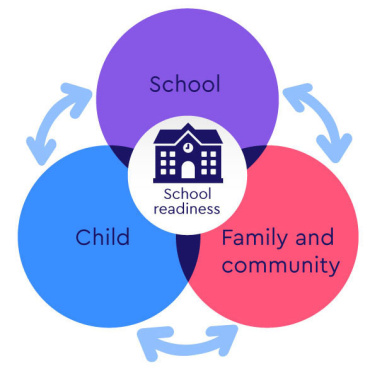
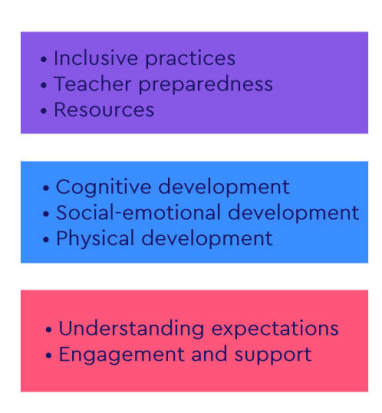
This framing moves responsibility from families and children alone, recognising the role of schools and communities in supporting children and their families during the early years and through the transition to primary school.
Evidence and learning from the five ABS partnerships suggests taking this broader, more holistic view of school readiness supports children, practitioners and care givers to be school ready. This view sees school readiness as a journey from conception to reception, shaped by children’s experiences, environments and relationships.
Find out more about learning from the ABS partnerships on supporting school readiness in each of these three dimensions of child, school, and family and community, including reflective questions and resources to support your practice. The shared learning draws from the four main outcome areas that ABS focused on (diet and nutrition; social and emotional development; language and communication; and systems change) and so does not capture all aspects of school readiness, for example mathematical development.