
Care experienced young people have much higher levels of mental health difficulties than their peers.
An engagement award on the mental health and wellbeing of youth in care and care leavers has filled a previous gap in the consensus about where research efforts should be focused with this important group. Findings from the programme as a whole are contributing to this agenda.
Identifying mental health difficulties among care-experienced young people
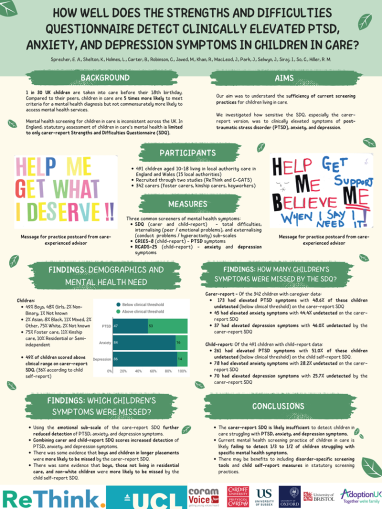
Methods for screening mental health difficulties among care-experienced young people are challenging. A review from the engagement award on the mental health and wellbeing of youth in care and care leavers found a lack of consensus and a diversity of measures being used in research, with a panel of experts recommending only the Strengths and Difficulties Questionnaire (SDQ) and the Revised Children’s Anxiety and Depression Scale 25 (RCADS-25) for routine use in research with this group of young people.
However, the ReThink study has found that the carer-reported total score on the SDQ misses a large proportion of children and young people who score in the clinical range on PTSD, anxiety or depression symptom measures. Integrating young people’s own reports, and symptom measures for specific disorders could improve current mental health screening practices for children in care.
Understanding care-experienced young people’s mental health and wellbeing
Evidence on the wellbeing of care-experienced young people in the UK, and how this intersects with their mental health, has been lacking.
The sizeable samples of 10-13 and 16-17-year-olds recruited to the ReThink study have provided new evidence, with the majority of young people in both age groups reporting clinically high levels of symptoms, and mental health and wellbeing being particularly poor in the older teens, particularly among those living in non-family-style care (e.g. residential accommodation).
Overall, mental health and wellbeing were moderately related to each other but these two aspects were more strongly associated in the older age group. Many of the younger children struggling with their mental health still had okay wellbeing, suggesting early intervention may be particularly fruitful.
More findings from ReThink are shortly to be published, including evidence that while care-experienced young people’s circumstances are unique and often complex, the core psychological and social drivers of mental health and wellbeing mirror what we see in other groups of young people.
Relational stability and continuity of care, decision-making and emotional support are foundational to mental health and wellbeing. However, social support on its own is often not enough if a child is struggling with high mental health needs, particularly as caregivers often lack agency in decision-making to find support for the child in their care.
Members of the ReThink team have developed national recommendations for evidence-based mental health provision for looked-after children in collaboration with CoramBAAF and the UK Trauma Council.