
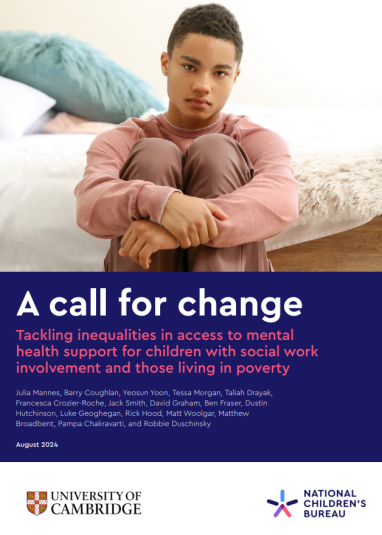
Analysis by researchers at Cambridge University and NCB of more than 71,000 children’s health records shows that despite it being well established that these vulnerable children are more likely to suffer mental health conditions, they are also more likely to be refused access to NHS Child and Adolescent Mental Health Services (CAMHS).
The findings are the first outputs from the COACHES study, a four-year collaboration between the University of Cambridge, Kingston University, King’s College London, NCB, the British Association of Social Workers (BASW) and the Care Leavers Association examining data across two NHS trusts.
Consultations with practitioners, clinician interviews, and analyses of health records indicate that the likelihood of refusal may be because these children’s circumstances are considered too “unstable” for mental health support. However, existing evidence suggests that some treatments can be helpful even when a child experiences ‘instability’.
The research uncovers how children are more likely to be rejected by CAMHS than their peers if they have social work involvement for current concerns, whether that is because they are being supported by social workers generally or are on child protection plans.
Children on child protection plans are twice as likely to be turned away by NHS mental health services, while children with other social work involvement are over three times as likely to be denied help compared to their peers. Children and young people who are living in care are less likely to be rejected in the NHS Trust at the heart of the study, which may be because it has dedicated services for children in care.
The traumatic impact of abuse and neglect increases the likelihood of children developing a range of mental health issues so children with current concerns known to social workers should be prioritised - yet concerningly these findings show the reverse.
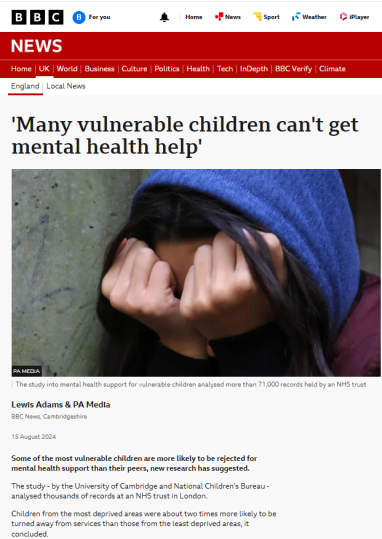
Years of underfunding and rising levels of need have reduced capacity within CAMHS, hindering its response to children whose situations are considered too unstable to make the most of available services. Furthermore, mental health and children’s social care teams often do not have the systems and resources to join up their work when there are current concerns. The combined effect results in already vulnerable young people having their mental health systematically neglected.
The research also highlights how all children growing up in the most deprived areas are at risk of having their mental health needs going untreated, with those in the poorest localities twice as likely to be refused mental health support compared to those living in the richest neighbourhoods.
The analysis considers young people ‘accepted’ by CAMHS even if they are just offered an appointment; this is distinct from whether young people are able or willing to attend. Additionally, some children referred to CAMHS might not meet clinical thresholds, and other sources of support may indeed be more appropriate. However, poor outcomes suggest that lack of access to mental health support for many young people with social work involvement can have devastating implications.
Upon their publication in 2024, the findings prompted the Children’s Charities Coalition (the now defunct coalition between Action for Children, Barnardo's, NCB, NSPCC and The Children's Society) to call on the government to create a joined-up, cross-departmental approach to solve failings that see a care system at breaking point, soaring levels of child mental illness, and millions being swept into poverty.