
Running from the 8-14 June, Infant Mental Health Awareness Week (IMHAW) 2026 will provide an opportunity to highlight the importance of supporting babies’ mental health and wellbeing.
Lisa Storey, the Child Development Interventions Coordinator (CDIC) from the Western Health and Social Care Trust, has written the following article, breaking down this year's IMHAW theme and offering book recommendations and resources.
With 17 years of experience working with families and infants, I am deeply committed to promoting the importance of the first 1,001 days, alongside early intervention and preventative support.
My passion is both professional and personal. As a mother of three, I have first-hand experience navigating complex medical challenges, including my eldest child’s liver transplant during his first year of his life, which has driven my advocacy for organ donation.
In 2018, I co-founded Altnagelvin Parents Group, a local charity dedicated to supporting families of children with lifelong and life-limiting complex medical conditions attending Altnagelvin Hospital. It is a charity for parents, run by parents.
Infant Mental Health Awareness Week 2026: Attunement
Attunement is the theme of this year's IMHAW, bringing attention to the vital role early relationships play in shaping lifelong wellbeing. In an increasingly fast-paced and digitally distracted world, understanding how caregivers connect with and respond to their infants during the first 1,001 days has never been more important. This feature explores why tuning into babies’ emotional needs is essential, and how small, everyday interactions can have a lasting impact on a child’s development.
In a year when early intervention and prevention remain firmly at the forefront of agendas, Infant Mental Health Awareness Week 2026 arrives as a moment for both reflection and renewed commitment. At its heart lies a deceptively simple theme, attunement. One that calls attention to the profound, often underestimated power of emotional connection in the earliest stages of life.
Attunement describes the delicate, ongoing process through which a caregiver notices, interprets and responds to an infant’s cues. A cry, some lovely eye contact, a subtle shift in posture; each is part of a baby’s emerging language.
To be attuned is not to respond perfectly every time, but to engage consistently and sensitively; to be, in the words of developmental psychology, “good enough.” These everyday exchanges, repeated countless times, quietly shape the architecture of the developing brain, laying the foundations for emotional regulation, resilience and secure relationships.
The significance of this process becomes even clearer when viewed through the lens of the first 1,001 days, from conception to a child’s third birthday. This period represents a window of unparalleled neurological growth, during which neural pathways are formed at extraordinary speed. Positive, responsive caregiving strengthens these connections, while prolonged stress or neglect can disrupt them. In this sense, infant mental health is inseparable from physical health; each informs and reinforces the other.
Yet the conditions in which families are raising young children today are more complex than ever. Modern life is saturated with digital stimuli. Smartphones, social media and on-demand platforms have become constant companions, often competing for attention during moments that might otherwise foster connection. It is now a familiar sight: a parent scrolling through a device while feeding their baby or a toddler soothed with a screen rather than engaged through eye contact and conversation.
Technology offers convenience, information and, at times, much-needed respite. But its presence can interrupt the subtle, reciprocal exchanges that underpin attunement. These small interactions are the building blocks of healthy emotional development.
Parenting has always been demanding, and today’s caregivers often face significant pressures: financial strain, reduced community networks and the expectation to remain constantly connected to both work and home life. In this context, digital tools can feel less like a choice and more like a necessity.
Understanding the importance of attunement enables parents and professionals alike to make small but meaningful adjustments. Setting aside a phone during feeding or play, responding to a baby’s babble with eye contact, speech and touch, or simply observing and learning an infant’s unique cues, these shifts have lasting impact.
Parenting has always been demanding, and today’s caregivers often face significant pressures: financial strain, reduced community networks and the expectation to remain constantly connected to both work and home life.
Crucially, attunement benefits not only the child but the caregiver as well. A strong emotional connection fosters confidence, satisfaction and a deeper sense of purpose in parenting. This reciprocal relationship underscores a broader truth: infant mental health is not solely a family concern, but a societal one.
Practitioners play a pivotal role in advancing this understanding. By embedding infant mental health into everyday practice, offering practical guidance on responsive caregiving and acknowledging the realities of contemporary family life, they help translate knowledge into action. The challenge is not simply to inform, but to support, to create systems that make attunement possible, even in the face of competing demands.
Infant Mental Health Awareness Week serves as a valuable focal point, but its message must extend far beyond a single week. Sustained investment in early years services, accessible parental support and clear public health messaging are essential if all families are to thrive. The early years are not a niche concern; they are the foundation upon which lifelong health and wellbeing are built.
This commitment will be explored further in depth on Tuesday 9 June and Thursday 11th June 2026.
Tuesday 9 June 2026
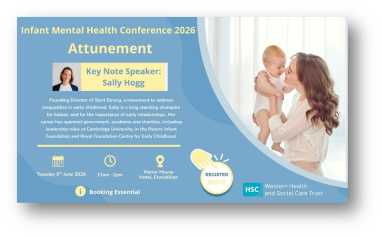
Will see practitioners from across sectors within the Western Health and Social Care Trust gather at the Manor House Hotel for a dedicated conference on infant mental health. The event will bring together strategic leaders and frontline practitioners to examine how services can align with the developmental needs of babies.
Delivering the keynote address will be Sally Hogg, founding director of Start Strong and a leading voice in early childhood policy. With a career spanning government, academia and the third sector - including roles at the University of Cambridge, the Parent-Infant Foundation and the Royal Foundation Centre for Early Childhood, Sally brings a wealth of insight into the intersection of research, policy and practice.
Her work consistently highlights the central role of early relationships in shaping cognitive, emotional and social development. Her message is unequivocal: responsive caregiving is not merely a private responsibility, but a collective one, requiring coordinated and sustained engagement across society.
Tuning in, noticing and responding to our babies is vital - it is perhaps the most important thing a caring adult can do for a baby, it’s also what we need to do as a society: to pay attention to what is happening for our babies, and to respond to their needs.
Sally Hogg
Founding director of Start Strong
Event details:
Date: Tuesday 9 June 2026
Information Stands Available: 10am-11am
Conference Time: 11am– 2pm
Location: Manor House Hotel, Enniskillen.
Booking is essential, as places are limited.
Thursday 11th June 2026
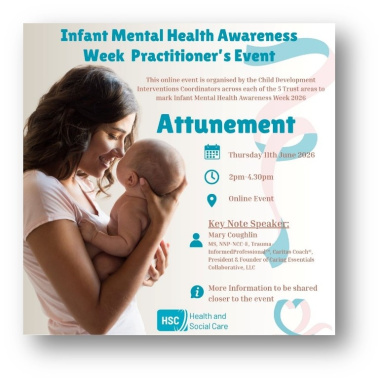
The Child Development Interventions Coordinators from across Northern Ireland are pleased to invite practitioners from all sectors working to support families in respective Trust areas to an online event in recognition of Infant Mental Health Awareness Week 2026.
This session aims to raise awareness of this year’s theme, attunement, and to explore its importance in supporting infant mental health.
Mary Coughlin, founder and president of Caring Essentials Collaborative LLC, and a published author and internationally recognised expert in the field of trauma-informed age-appropriate care, will deliver the keynote address.
Mary has mentored close to 10,000 interdisciplinary clinicians from over 14 countries to transform the experience of care for the hospitalised infant and family in crisis. Mary has been a speaker at various national and international conferences in addition to her passion in educating, coaching and mentoring clinicians and administrators transforming the culture of care.
These events encourage practitioners to consider how in their roles, whether strategic or in direct practice, can better support those earliest relationships. At a time of increasing demand and constrained resources, it poses a critical question: how can we ensure that babies’ experiences are prioritised, protected and properly understood?
In an increasingly fast-paced, digitally driven world, attunement asks something deceptively simple of us: to slow down, to notice, to connect. It prioritises presence over perfection, and relationship over routine. For infants, these early experiences are not fleeting, they are formative.
By tuning in during the first 1,001 days, we do more than support the immediate wellbeing of children. We shape the future mental health of our communities. The message is both simple and profound: when we respond to babies with sensitivity and care, we give them the strongest possible start in life.
Attunement is not perfection - it is noticing, responding, and repairing. Babies develop emotionally through relationships, not just routines. Secure attachment forms through repeated experiences of feeling seen, soothed, safe, and understood.
Event details:
Date: Thursday, 11 June 2026
Time: 2:00pm – 4:30pm
Platform: Microsoft Teams (Webinar)
Focusing on attunement, attachment, and infant mental health in the first 1,001 days
Below is a list of recommended books and podcasts for practitioners, parents and children to enjoy exploring, as well as the links to book a place at the event on 11 June.
Books for Adults
• The Book You Wish Your Parents Had Read by Philippa Perry. A highly readable introduction to emotional attunement, rupture and repair, and how early relationships shape development.
• Why Love Matters by Sue Gerhardt. One of the clearest books explaining how early emotional experiences shape the developing brain.
• Hold On to Your Kids by Gordon Neufeld and Gabor Maté. Explores why secure attachment relationships are foundational for emotional development and resilience.
• The Whole-Brain Child by Daniel J. Siegel and Tina Payne Bryson. Accessible neuroscience for parents and caregivers, with practical ways to support emotional regulation and attunement.
• Being There: Why Prioritizing Motherhood in the First Three Years Matters by Erica Komisar. A thoughtful exploration of emotional presence and attachment in early childhood.
• What Happened to You? by Oprah Winfrey and Bruce D. Perry. An accessible introduction to trauma-informed thinking and the lifelong impact of early relationships.
• The Mental and Social Life of Babies by Kenneth Kaye. This book is a reflective and developmental look at how babies become people through relationships and interaction.
• Transforming Infant Wellbeing: Research, Policy and Practice for the First 1,001 Critical Days edited by Sally Hogg, Jane Barlow and contributors. This book features research and policy-informed work focused directly on the first 1,001 days.
Children’s Books About Feelings, Connection & Emotional Safety
• The Rabbit Listened by Cori Doerrfeld. A beautiful demonstration of emotional attunement and presence.
• In My Heart: A Book of Feelings by Jo Witek, illustrated by Christine Roussey. A gentle, visually rich exploration of emotions.
• The Color Monster by Anna Llenas. Excellent for toddlers learning emotional language and regulation.
• The Feelings Book by Todd Parr. Inclusive and reassuring for very young children learning about emotions.
• Under the Love Umbrella by Davina Bell, illustrated by Allison Colpoys. A warm story about unconditional love and emotional safety.
• Big Feelings by Alexandra Penfold, illustrated by Suzanne Kaufman. Normalises overwhelming emotions and co-regulation.
• The Kissing Hand by Audrey Penn. A classic story about separation anxiety and reassurance.
• Grumpy Monkey by Suzanne Lang, illustrated by Max Lang. Encourages emotional validation rather than suppression.
• When Sophie Gets Angry - Really, Really Angry by Molly Bang. A sensitive exploration of emotional overwhelm and recovery.
Podcasts
• Good Inside with Dr. Becky hosted by Becky Kennedy. Accessible discussions on connection, co-regulation, emotional safety, and repair.
• Unruffled by Janet Lansbury. Grounded in respectful parenting and attuned caregiving.
• The Motherkind Podcast hosted by Zoe Blaskey. Thoughtful conversations around matrescence (the profound physical, psychological, and emotional process of becoming a mother), emotional wellbeing, and parent-child relationships.
• On Being hosted by Krista Tippett. Explores compassion, emotional presence, and human connection.
• The Parenting Junkie Show by Avital Schreiber-Levy. Attachment-focused parenting conversations made approachable.
• Raising Good Humans hosted by Aliza Pressman. Covers mindful parenting, emotional regulation, and secure attachment.
• Huberman Lab hosted by Andrew Huberman. Includes valuable discussions on attachment and relational neuroscience, especially episodes featuring Allan Schore.