
A new digital toolkit provides guidance, resources and real-world examples to strengthen the ethical and effective use of children's information in local authorities.
Effective information use depends on key principles and methods. It goes beyond gathering data and requires the right systems to support informed decision-making. Between 2021 and 2026, the Children’s Information Project undertook research into local authorities’ use of information about children, young people and families.
Drawing from these findings, the toolkit supports teams to build a comprehensive picture of children's needs, trajectories and outcomes. It ensures the diverse voices of children, young people, parents and carers are heard clearly within information systems, valuing their lived experiences just as much as quantitative data.
The resource contains clear definitions, practical tools and examples of what ethical and effective information use looks like in local authority settings. Ethical practices such as transparency, equity, and respect for rights are key to achieving positive outcomes.
By making sure authentic voices shape how information is gathered and shared, services can be better tailored to local community needs.
A toolkit for the ethical and effective use of children's information
This digital toolkit brings together helpful guidance and tools for practitioners and data leads to strengthen information use.
Developing the toolkit
The toolkit was co-developed based on the information use framework, supported by a learning network made up of practice leads and data leads from 20 local authorities. This means it is deeply rooted in frontline practice and operational realities.
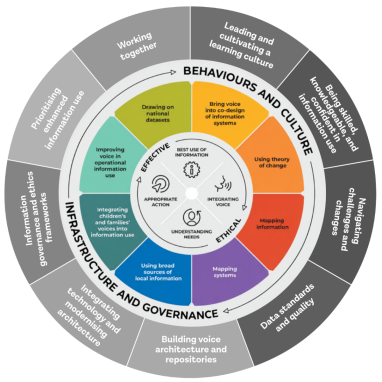
The framework shows that ethics and effectiveness go hand in hand. It is structured across three main layers:
- Four core approaches that outline what we want to achieve and why.
- Eight information use practices that define how to bring the approaches to life through operational methods.
- Systems enablers that explore the essential conditions needed for success, split into human elements (Behaviours and Culture) and scaffolding (Infrastructure and Governance).
About the Children’s Information Project
The Children’s Information Project was a major five-year initiative that aims to improve the way that information about and from children, young people and families is used in local and national Government.
Funded by the Nuffield Foundation, the project was hosted by the University of Oxford in partnership with the University of Sussex, the London School of Economics, Research in Practice (part of the National Children's Bureau), and four local authority partners: Hampshire, North Yorkshire, Oldham, and Rochdale.