Lessons learned? Investigating the inequalities faced by Black and Global Majority children and young people in need of mental health support

Lauren Archer, DEI Senior Programme Lead at the National Children’s Bureau (NCB), and Dr Yeosun Yoon, NIHR Research Associate in Data Science in the Child Health and Development Research Group at the University of Cambridge, reflect on preliminary findings from a collaborative research study examining the experiences of young people in the social care system accessing mental health services.

Our COACHES study, which is coming to a close after four years, has shed new light on the experiences of how young people with social care involvement who need mental health support are assessed and treated by NHS Children and Adolescent Mental Health Services (CAMHS). 

The project is a collaboration between University of Cambridge, Kingston University, King’s College London, NCB, the British Association of Social Workers (BASW) and the Care Leavers Association examining data from over 100,000 children and young people aged 4-18 across two NHS trusts between 1997 and 2023.

As part of the study, we examined four commonly used "psychosocial" treatments that may be offered to children and young people attending CAMHS following referral and assessment. 

A psychosocial intervention is a treatment aimed at helping people to feel better, handle problems, manage emotions, and to get along with others through talking, support groups, learning life skills, and social activities. 

Our research has found significant improvements in mental health outcomes over time among the children and young people receiving these psychosocial interventions. 

Of the 101,734 referrals to CAMHS between 1997 and 2023 reviewed by our study, approximately 10% resulted in children and young people receiving at least one treatment of cognitive behavioural therapy (CBT), dialectical behaviour therapy (DBT), creative therapies, or psychodynamic or counselling-based therapy.  However, the proportions of children and young people who received that support varied across different ethnic groups.

Find out more about the COACHES study

Among the children and young people referred to CAMHS, 13% of referrals involving white children and young people included a psychosocial treatment, compared to 9% involving Asian children and young people and just 8% of referrals involving Black children and young people.

Image
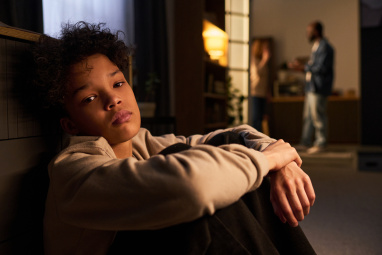
Teenage boy sat looking sad while adults argue in the background

These preliminary findings suggest that there are inequalities in access to psychosocial interventions within CAMHS, despite evidence that these interventions are associated with improved mental health outcomes regardless of a child or young person's social work involvement, ethnicity, or level of local deprivation.

On their own, these findings cannot explain why these differences exist or provide unequivocal evidence of any single cause. They do, however, raise important questions about inequalities in access to mental health support. 

It is important not to interpret lower rates of psychosocial treatment as meaning Black and Global Majority children and young people have lower levels of mental health need. 

The reality is that experiences of racism may actually compound these needs. Studies [1] have shown that Black and Global Majority children who experience racism are at higher risk for developing mental health issues like depression, anxiety, post-traumatic stress disorder (PTSD), and low self-esteem in adolescence and adulthood, as well as being more likely to fall back on potentially harmful coping mechanisms such as smoking or substance use, which can contribute to longer-term mental and physical health complications.

Research [2] also shows that there are also disparities in how these issues are diagnosed and responded to. There are a range of barriers and inequalities that may affect whether children and young people are able to access timely and appropriate mental health support. 

Black and Global Majority children’s mental health may be ignored or under-diagnosed, while at the same time their distress may be over-pathologised, met with disproportionate force, or responded to through crisis routes rather than early support. This paradox of being simultaneously invisible and hyper-visible is evident across systems that disadvantage certain groups.

These can operate at different points along the pathway: before a child reaches services, when concerns are identified and referred, during assessment, and in decisions about the support that is offered. They may include difficulties accessing or understanding the availability of help, mistrust of services, complex referral pathways, geographic and socioeconomic inequalities, pressures on under-resourced services and the influence of assumptions or institutional practices.

Black and Global Majority children’s mental health may be ignored or under-diagnosed, while at the same time their distress may be over-pathologised, met with disproportionate force, or responded to through crisis routes rather than early support. This paradox of being simultaneously invisible and hyper-visible is evident across systems that disadvantage certain groups.

Together, this wider evidence suggests that the underrepresentation of Black and Global Majority children and young people in some forms of mental health support may reflect unequal access to services and support rather than lower levels of need.

This is why it is important to just ask why some groups appear less likely to receive particular treatments, but what happens within systems that may mean that support does not reach all children at the same rate. 

Image
A Black schoolchild holds her head in her hand while sat next to a white classmate

To understand this fully, it is also necessary to consider the longer historical context in which ideas about race, Blackness and mental health developed. Racialised assumptions about Black people's mental health did not emerge in a vacuum. They have a history that can be traced back to slavery and the use of medical and psychiatric ideas to justify racial oppression.

One of the clearest examples can be seen in the pseudo diagnosis of ‘Drapetomania’. This was a false diagnosis created by American physician Samuel Cartwright in the 19th century, who claimed that enslaved Black people who attempted to escape were suffering from a mental illness.  Rather than recognising resistance as a rational response to oppression, the system framed the desire for freedom as evidence of individual pathology (see for example: Under the shadow of Tuskegee: African Americans and health care - PMC).

This history can provide helpful context for interpreting the new evidence from the COACHES study. The disparities in access to psychosocial interventions within CAMHS raise important questions about how mental health need is identified, whose distress is recognised, and why there are inequalities in the way that children are responded to.  

Addressing inequality today requires a recognition of how historical narratives continue to shape modern institutions, and a focus on designing mental health services around inclusion, early intervention, and an equitable response to every child’s distress. 

When we publish the final findings from the COACHES project early next year, we will be able to dig a little deeper in our understanding of why there are disparities in the assessment and treatment of children and young people’s mental health and develop proposals for how to address them. 

We hope that sharing this evidence and subsequent recommendations to inform positive change in policy and practice will contribute towards a more equitable system of social care and mental health services that are accessible and effective for everyone who needs them. 

[1] See for example: 

[2] See for example: