As the COACHES project comes to a close after four years of collaborative study into the mental health services received by children and young people with social work involvement, researchers presented their findings at an event at Sidney Sussex College, Cambridge.
“We hope this research strengthens existing conversations and makes room for new ones.”
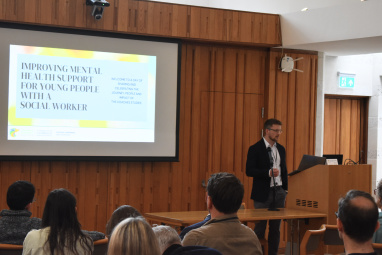
It was with these words that Barry Coughlan, British Academy Postdoctoral Research Fellow, Department of Public Health and Primary Care at the University of Cambridge, opened Improving Mental Health Support for Young People with a Social Worker, an event to share and celebrate the journey and impact of a groundbreaking four-year collaborative research study.
Over 100 invited participants from academia, frontline social work and mental health services, charities, funding organisations and government departments assembled at Sidney Sussex College, Cambridge to hear the conclusions and methodology of the COACHES project.
Launched in October 2022, the Child and Adolescent Mental Health Services Referrals and Outcomes for Adolescents and Children with Social Workers (or COACHES for short) project examined data from over 100,000 young people across two NHS trusts in a collaboration between NCB, the University of Cambridge, Kingston University, King's College London, the British Association of Social Workers (BASW) and The Care Leavers Association.
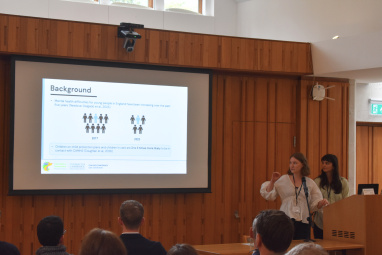
Dr Tessa Morgan and Julia Mannes from the University of Cambridge, summarised the project’s approach and topline findings in response to two key questions:
- What is the likelihood of young people with social work involvement receiving access to CAMHS support compared to their peers?
- How are young people with social work involvement characterised in their CAMHS case notes?
The study found that despite children and young people with social work involvement being more likely to experience mental health difficulties than their peers, and therefore more likely to be in contact with NHS services, they were actually two to three times less likely to receive treatment and support from CAMHS.
Analysis of thousands of case notes revealed that many of these children were rejected because their home environments were deemed too “unstable” or “chaotic”.
Qualitative contributions by young people and parents with direct experience of mental health and wellbeing interventions within the social care system have been at the heart of the project.
This quote from Taliah Drayak, one of COACHES expert-by-experience co-researchers was shared by Julia and Tessa:
As a child you can't access what you need without support, and when the adults in your life become barriers to accessing what you need, the message that you write upon your heart is I am not good enough, I do not deserve, and I am the problem. When the support services that are there to help only seem to help others and not you, you develop negative coping strategies that impede your wellbeing and capacity to achieve for life. Instead of first being a barrier, and then teaching children to be our own barriers, children need mental health services to be an inclusive beacon of hope and support.
Taliah Drayak
Another expert-by-experience researcher, Jack Smith, addressed the event and explained how his COACHES work with Cambridge and the Care Leavers Association had helped to shape a set of recommendations for prioritising and protecting emotional safety during co-production.
I think the point about managing distress and not making it go away is important. Sometimes researchers think they need to put a barrier up and you can only cross over into this work if you are going to become a professional. But speaking from the heart is what experts-by-experience are good at which is why celebrating emotion is really key.
Jack Smith
Dr Yeosun Yoon, another member of the Cambridge team, presented findings of her research that showed that Black and Asian children and young people were less likely to receive treatments from CAMHS than their white peers, even though the effectiveness of those treatments was shown to not be related to ethnicity.
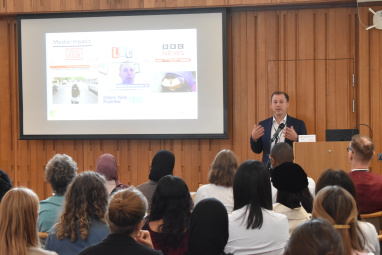
COACHES’s policy and communications impact was outlined by Dustin Hutchinson, Visting Researcher at the University of Cambridge and formerly NCB’s Senior Policy and Public Affairs Manager, who described how more than 100 officials from NHS England and government departments were engaged during the project, with coverage secured on the BBC, in The Big Issue and on LBC radio.
Read a briefing on the COACHES evidence presented to policymakers
Following the keynote presentations, participants were able to hear from a host of other researchers with both lived and learned experience on related research and insights on improving CAMHS mental health provision for young people with social work involvement, before the day finished with workshops discussing potential avenues for future research and a poetry workshop run by poet and author Laura Mucha.
The following poem, Patient 11, was created by the participants of Laura’s workshop and provides a powerful summation of the frustration felt by many young people with social work involvement and their families navigating mental health support today:
Child living in poverty.
Chaotic life.
Therefore self-harming.
Won’t treat.
What’s the point?
I’m scared,
there’s so much noise.
confused – lost - angry
Is it my fault?
Behavioural,
not mental health.
Mother needs to work on
organisation.
Child needs more stability.
Onwards referral.
Information sheet given.
When do I stop being a record?
I don’t have anyone.
What do I have to do
to get help?
Hearing voices,
restrictive eating,
dissociation,
aggression to others.
No significant
mental health issues.
Doesn’t meet threshold.
Why can’t they see me?
I’m more than a shopping list.
I wonder what it’s like to get care.
this – is – not – for – you
They’re just like all the rest.